A City Improvement District (CID) refers to a clearly defined geographical area, in which property owners contribute additional rates to fund supplementary municipal services for that specific area as per a community supported Business Plan approved by Council. Council determines an area as a special rating area, which then functions as a CID to improve and upgrade the area for an initial 5-year term.
CIDs are governed by Section 22 of the Municipal Property Rates Act (MPRA), the Companies Act (Non Profit Company - NPC), the SA Constitution and the City of Cape Town’s City Improvement District By-law of 2023.
According to the SA Constitution (Sections 152 & 153), the objective of a local authority is to provide all its residents with certain basic services such as water, electricity, sanitation and refuse removal, etc. – up to an equitable standard. For communities who wish to enjoy municipal services of a higher level, a CID provides them with the option of paying for these additional services, which should be affordable and sustainable.
Typically, these would be services dealing with Urban Management issues like additional public safety measures, cleansing services, maintenance of infrastructure, environmental initiatives, and social interventions, etc.
No. The City is obligated to sustain existing service levels and to provide basic services as per the Constitution. Each CID will engage with the various service departments regarding the level of services provided by the City in their area. This enables the CID to deliver services in addition to what the City delivers.
By pooling their resources in a CID, individual property owners can enjoy the collective benefits of a sustainable well-managed area, a shared sense of communal pride, safety and social responsibility, and access to joint initiatives such as waste recycling, energy-efficiency programs, etc. In the end, these all contribute to economic growth and an inflow of capital investments.
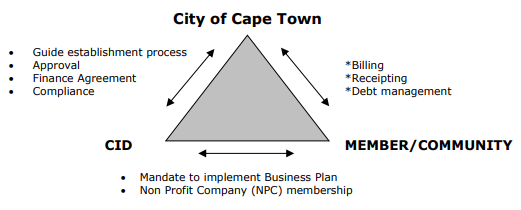
After Council has approved the application, a Non-Profit Company (NPC) with members is set up by the Steering Committee who becomes the founding directors of the NPC. Within 6 months of setting up the NPC the first Members` Meeting is held to elect a board of directors. The NPC has to register for VAT, open a bank account and register as a supplier with the City and on the National Treasury Central Supplier Database (CSD). A Finance Agreement must then be concluded between the City and the NPC, which sets out the terms on which payments to the CID is made. This must all be in place before the City makes any payment to the CID. In the first year of operation, the NPC must submit an application to SARS for tax exemption.
In the year prior to the term expiry, the CID is required to make application to Council for a further term by submitting a new community supported Business Plan.
A CID is a NPC managed by a board elected by its members, and operated by a management team appointed by the board. The City is not involved in their day-to-day operations, but merely exercises oversight and legal compliance. A Councillor is appointed by the Executive Mayor to attend the CID Board meetings as an Observer facilitating the City’s oversight of the NPC.
Yes, all property owners can participate in the affairs of the CID, but only members can vote at Members Meetings (e.g. AGM). Every property owner within the CID should apply in writing to the CID Board for membership of the NPC.
Property owners liable for the additional rate are not automatic members and can sign up for membership to allow them to vote on the affairs of the CID. Property owners who receive a rates rebate are exempt from the additional rate and cannot apply for membership.
A CID is governed by the Companies Act (71 of 2008), manages its own finances and appoints its own service providers, accountant and auditor. CIDs are required to submit audited financial statements to the City annually for review and presents it at their Annual General Meeting (AGM) for adoption by the members. In addition, monthly financial reports are submitted to the City to monitor and to ensure that expenditure is incurred according to the approved budget. All CIDs have to submit their Annual Report and Annual Financial Statements to the relevant Subcouncil and CID Branch, within three months of their AGM, for noting.
A CID is funded from the additional rates paid by property owners within the boundary of the CID. It does not receive any grants or subsidies from the City, but does have the powers to raise additional income.
The CID confirms the properties within the boundaries of the CID, which is linked to the municipal valuations according to the most recent general valuation roll. The CID annually prepares an overall budget for the year. This is based on the specific needs of the area as set out in the approved Business Plan. Individual contributions are then calculated by dividing the budget total according to the municipal valuations of each property, proportional to the total valuation of the CID. The CID Policy allows for a differentiation in tariffs for the different types of properties – be it residential, commercial or industrial. This tariff is then expressed as a rate in the rand and is applicable over a financial year, which starts on 1 July. The CID budget and proposed tariff have to be approved by Council, and advertised for comments and objections as part of the City’s budget process prior to implementation on 1 July.
The CID sets its own budget according to input from its members as per the approved five-year Business Plan. Each year, the CID board has to submit a detailed budget to the City by 31 January. The proposed budget may not deviate materially from the approved business plan and must have been approved by the members at the last AGM. If there is a material deviation, an application in terms of Section 26 of the CID By-Law is required. The City evaluates the proposed budget for affordability and sustainability.
The City collects the additional rates in the same manner as other property rates imposed by Council. The additional rate appears as a separate item (improvement district) on the monthly municipal account of each property owner liable to pay the CID additional rates within the CID.
Defaulters are subject to the City’s credit control and debt collection policies. As such, they can have their water and electricity services suspended or their clearance certificates withheld.
Yes. Once Council has approved a CID, the participation of all property owners liable to pay the CID additional rates, within the boundaries of the CID, is mandatory. However, there are exceptions for those property owners who qualify for exemption.
The following categories of owners / properties will be 100% exempt as per the CID Policy:
• Indigent, Senior Citizens and Disabled Persons who meet the criteria for rates relief
• Council owned properties used predominantly for official municipal business
• Properties owned by an organisation – not for profit and used as an early childhood development facility
• Properties owned by an organisation – not for profit and used for youth development
• Properties owned by an organisation – not for profit and used as accommodation for the vulnerable
• Properties owned by an organisation – not for profit and used for an old age home
• Properties owned by an organisation – not for profit and used exclusively for amateur sport
• Properties owned by a Social Housing Regulatory Authority accredited Social Housing Institution and used for social housing
• Properties owned by war veterans’ associations and used for the welfare of war veterans
• Properties owned by public benefit organisations and used for specified public benefit activities
• Properties owned by a religious community and used for specified religious purposes
• Cemeteries and Crematoria
• Properties owned by an organisation – not for profit and used for animal shelters
• Properties owned by an organisation – not for profit and used as a local community museum
• Nature conservation land
The valuation base is a snapshot at a point in time (end February) and is used to calculate the additional rate (rate in the rand) for the following financial year. However, municipal valuations can change within a financial year due to supplementary valuations, Valuation Court rulings, sub-divisions, rezoning or other technical adjustments. Should the valuation base decrease or increase substantially, the City must inform the CID in order to assess the potential impact on the CID’s additional rate and/or budget.